

Currently Empty: $0.00

About Course
Overview
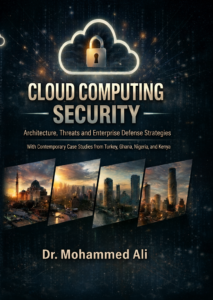
Cloud Computing Security: Architecture, Threats, and Enterprise Defense Strategies is a comprehensive graduate-level textbook that bridges the critical gap between theoretical security principles and their practical application in modern cloud environments. Written by Dr. Mohammed Ali, who holds an Ed.D. in Educational Leadership from Morgan State University (2018), this book brings a systematic, evidence-based approach to cloud security education. His doctoral research examined how student-technology interaction affects satisfaction and learning outcomes in online education—a perspective that informs the book’s emphasis on how organizations and individuals interact with security technologies.
The book is structured as a complete 8-chapter graduate course, designed to be delivered over a standard academic semester or used for self-study by professionals seeking to deepen their cloud security expertise. Each chapter includes clear learning objectives, comprehensive technical content, integrated case studies, review questions, and hands-on exercises accessible through the companion website at https://courses.beidat.com.
Hands-On Exercises
Each chapter includes practical exercises accessible through the companion website:
Chapter 1: Explore cloud service models and compare security responsibilities
Chapter 2: Scan container images for vulnerabilities and implement secure configurations
Chapter 3: Use CSPM tools to identify common misconfigurations
Chapter 4: Develop a comprehensive cloud risk register
Chapter 5: Implement least-privilege IAM policies with RBAC and ABAC
Chapter 6: Configure KMS with BYOK and test key deletion impact
Chapter 7: Design and implement a secure VPC architecture
Chapter 8: Build and test detection rules with SOAR playbook development
Target Audience
-
Graduate students in cybersecurity, computer science, and information assurance programs
-
Cloud architects seeking to incorporate security into their designs
-
Security professionals expanding their expertise to cloud environments
-
IT auditors and compliance officers navigating cloud regulatory requirements
-
Technical managers overseeing cloud security programs
-
Practitioners in Africa, the Middle East, and other rapidly developing regions seeking regionally relevant examples
Course Content
Cloud Computing Security Chapter 1 INTRODUCTION TO CLOUD COMPUTING AND SECURITY FOUNDATIONS
-
Chapter 1 Video and Textbook
00:00 -
Chapter 1 Presentation
-
Quiz 1
-
AWS Cloud Computing Security Course Assessment Platform
Chapter 2 CLOUD ARCHITECTURE AND VIRTUALIZATION SECURITY
CHAPTER 3: THE CLOUD THREAT LANDSCAPE
CHAPTER 4: CLOUD RISK MANAGEMENT
Midterm Exam
CHAPTER 5: IDENTITY AND ACCESS MANAGEMENT IN THE CLOUD
CHAPTER 6: DATA PROTECTION AND ENCRYPTION
CHAPTER 7: CLOUD NETWORK SECURITY AND ENTERPRISE ARCHITECTURE
CHAPTER 8: CLOUD SECURITY MONITORING, INCIDENT RESPONSE, AND FUTURE DIRECTIONS
Final Exam
Student Ratings & Reviews
This course is very good and easy to understand. Everything is explained clearly, and it helped me learn a lot about cloud safety
is good course
i had a great experience with this course. The content was very well organized, easy to follow, and highly informative. The instructor explained the concepts clearly and provided practical examples that made learning much easier.
this was great course, it helped more about cloud computing security.
good
 Teacher

 Admin
Admin